By the Jupitrr team · Last updated August 2026
What Is UGC Video?
UGC video is video made by customers or independent creators rather than a brand's production team: phone-shot, spoken to camera and personal. This guide covers the three things people now mean by UGC, how it differs from influencer content and AI-generated video, the nine formats brands use, and how UGC videos are actually made.
The short answer
UGC stands for user-generated content. A UGC video is a video about a product or service made by a user of it, or by a creator briefed to look like one, instead of by the brand's marketing team. It is usually shot on a phone, framed vertically, spoken directly to camera and cut quickly, and it is used everywhere from organic TikTok posts to paid Meta ads and product pages.
The term has stretched. Ten years ago UGC meant whatever customers posted on their own. Today most people who say "UGC video" in a marketing context mean content a brand commissioned from a creator specifically because it looks like a customer made it. And since 2024 a third category has appeared: videos in the same style generated by AI, with no person on camera at all.
The three share a look. They do not share a maker, a rights situation or a job, which is why it helps to name them separately.
The three things people mean by UGC video
Made by a real customer, unprompted
Organic customer UGC
A customer films a review, an unboxing or a “here is what happened when I tried it” video and posts it to their own account. Nobody briefed them. The brand may ask for permission to reshare or run it as an ad, and usage rights have to be agreed after the fact, because the customer owns the footage.
Made by a creator the brand hired
Paid creator UGC
A brand briefs an independent creator to make a video that looks and sounds like a customer made it: talking to camera, phone-shot, conversational. The creator is paid for the asset, usually with usage rights written into the agreement, and often does not post it to their own audience at all. This is what job boards, marketplaces and “UGC creator” profiles mean by UGC.
Made by software, no creator on camera
AI-generated UGC
A tool generates a UGC-style video from a script or a product URL using a synthetic presenter, a cloned voice and generated or stock product scenes. Vendors call this “AI UGC”. It borrows the look of creator content, but no user or creator produced the footage, and platforms increasingly require it to be labelled as AI-generated.
When a brief, a job post or a tool says "UGC" without qualifying it, it almost always means the second one: paid creator UGC. When a platform policy or a customer-review widget says it, it usually means the first. When an ad-generation tool says it, it means the third.
UGC vs influencer marketing
The cleanest way to separate them is to ask what the brand is paying for. Influencer marketing mostly buys distribution: a creator with an audience posts about the brand, and the value is their reach and their credibility with people who already follow them. UGC creator work mostly buys the creative asset: the brand receives the video, owns or licenses it, and runs it in its own organic feeds, paid ads, product pages and emails. The creator often never posts it and may have no audience of their own.
That changes who gets hired. Influencers are chosen for who watches them; UGC creators are chosen for how well they perform on camera and how much they look like the brand's customer. It also changes the economics: a UGC video is priced per asset, with usage rights (organic only, paid social, duration, territories) spelled out in the agreement.
The two overlap constantly. A brand can pay a creator for a video and also have them post it, then boost that post through TikTok Spark Ads or Meta partnership ads so the ad runs from the creator's handle, a practice usually called whitelisting. In that case the brand is buying the asset and renting the identity at the same time. Treat the distinction as a spectrum of what is being bought, not two separate industries.
Real creator UGC vs AI-generated UGC
AI-generated UGC replaces the person. A tool takes a script or a product URL and produces a video with a synthetic spokesperson or avatar, a generated or cloned voice, and product scenes that are either stock, uploaded or generated. Some tools let you clone a real creator's likeness with their permission; most offer a library of stock presenters. The output is designed to look like paid creator UGC, which is why vendors market it under the same word.
Real creator UGC involves a person who actually handled the product and recorded themselves. The footage carries their delivery, their room, their phone camera and their mistakes, and it can be reused on their own channels with the trust that comes from a face people can look up.
Where each one fits
AI-generated UGC is fastest at volume: dozens of script, hook and presenter variations for creative testing in an afternoon, in many languages, without booking anyone. Real creator UGC is slower and more expensive per video, but the product was genuinely used, the reactions are not scripted and the creator can be credited, whitelisted or brought back for a second round. Neither is universally better; many teams test with generated variations and scale the winning angles with real creators, or the reverse.
Labelling and disclosure
The rules now separate them formally. TikTok has required creators to label realistic AI-generated or significantly AI-edited content since September 2023, and prohibits AI content that presents a person as endorsing something they did not. Meta applies AI-info labels to AI-generated media. In the United States the FTC's Endorsement Guides, revised in 2023, apply the same disclosure duties to virtual influencers as to human ones. In the European Union the AI Act's transparency obligations for AI-generated images, audio and video took effect on 2 August 2026. If you are producing or buying AI-generated UGC, plan for the label; if you are producing real creator UGC, plan for the paid-partnership disclosure.
The nine UGC video formats brands use
Briefs mix and match these, and a single recording is often cut into two or three of them. Every one works as organic customer content or as a paid creator brief.
01
Talking-head testimonial or review
The creator speaks directly to camera about the problem they had, what they tried and what changed. The most common brief because it works for almost any product and needs nothing but a phone and a face.
02
Product demo
The product is used on camera while the creator explains what they are doing. Close-ups and a second angle of the product in hand do most of the work; the narration fills in why.
03
Unboxing and first impressions
Opening the package, reacting to what is inside and giving an honest first take. Works because the viewer discovers the product at the same moment the creator does.
04
Problem to solution
Opens on a relatable frustration, sometimes acted out, then introduces the product as the way past it. The hook is the problem, not the product, which is why this format survives being an ad.
05
Before and after
A visible change, shown honestly: skin, a room, a spreadsheet, a workout, a piece of writing. The evidence is the point, so the edit stays simple and the two states get equal screen time.
06
Tutorial or how-to
A step-by-step walk through of using the product to get a specific result. Longer than most UGC, and the format brands most often reuse on product pages and in onboarding emails.
07
Lifestyle and day-in-the-life
The product appears inside an ordinary routine rather than as the subject: the coffee, the commute, the desk. Low-key by design, and the format most likely to be posted organically.
08
Voiceover with product B-roll
The creator narrates over footage of the product in use, packaging, results and lifestyle shots, without appearing on camera for most of the video. Faster to shoot and easy to re-cut into several versions.
09
Green-screen and screenshot commentary
The creator reacts to a review, a product page, an app screen or an article shown behind or beside them. Screenshots double as social proof, which makes this a common format for software and services.
Where UGC videos show up
UGC started on the platforms where customers post, and it still lives there first: TikTok, Instagram Reels and YouTube Shorts for vertical short-form, and YouTube for longer reviews and tutorials. Brands then move the same footage into places customers never posted it.
Paid social is the biggest of those. Ads on TikTok and Meta that look like ordinary feed content are the reason paid creator UGC exists as a job, and TikTok's own creative guidance tells advertisers to make ads that look native to the feed rather than interrupt it. Beyond ads, UGC videos run on product and landing pages as social proof, in email and onboarding sequences as tutorials, in creator-led shopping formats such as TikTok Shop, and in the brand's own organic feeds between polished content.
The same recording can serve several of these if it was shot with that in mind: a clean product close-up, a version with and without the CTA, and a cut that works with the sound off.
What makes a video feel like UGC
The style is recognisable enough that AI tools can imitate it, which means it can be described. These are the observable traits, not rules; a video can break several and still read as UGC.
Direct-to-camera delivery
The creator talks to the viewer, usually at arm's length from a phone, in the first person. Eye contact with the lens and conversational phrasing ("okay so", "I did not expect this") do more than any filter to signal that a person, not a brand, is speaking.
Native framing
Vertical 9:16, handheld or propped on a desk, natural light, a real room in the background. Polish reads as an ad; a slightly imperfect frame reads as a post.
A hook in the first seconds
The first line states the problem, the result or a surprising claim, before the product is named. Dead air at the start, a greeting or a brand logo are the quickest ways to lose the scroll.
Fast pacing and visible cuts
Pauses, hesitations and repeated words are cut out, and the cuts are left visible as jump cuts rather than hidden. The rhythm changes every few seconds: a new angle, a product close-up, a screenshot.
Captions on by default
Most feeds autoplay muted, so spoken lines are captioned, often in a large, word-by-word style. Captions also carry the hook for people who read before they listen.
The product in use
Cutaways to the product being held, opened, applied or clicked are what separate a UGC video from a vlog. Those cutaways are B-roll, and the types of B-roll creators use map closely onto UGC: product close-ups, screen recordings, screenshots of reviews, lifestyle footage.
A CTA when it is an ad
Organic UGC often ends on an opinion. Paid UGC ends on a next step: a link, a code, a "try it". Brands usually ask for cuts with and without it.
How UGC videos are typically made
Organic UGC is made however the customer likes. Paid creator UGC follows a fairly consistent production loop, and it is short.
Brief and script
The brand sends a brief: product, audience, the angle, the format from the list above, length, deliverables and usage rights. The creator turns it into a script or a list of talking points, with the hook written first. Scripts are kept loose so the delivery stays conversational.
Record on a phone
Most UGC is shot on the creator's phone in one sitting, to camera, with extra product footage captured afterwards. Scripted videos are easier to record scene by scene than in one long take, which is the approach Jupitrr Cut is built around: the script splits into lines, each line is recorded until it lands, and the app trims the silence and stitches the takes into a jump-cut edit.
Edit: trim, caption, cut away
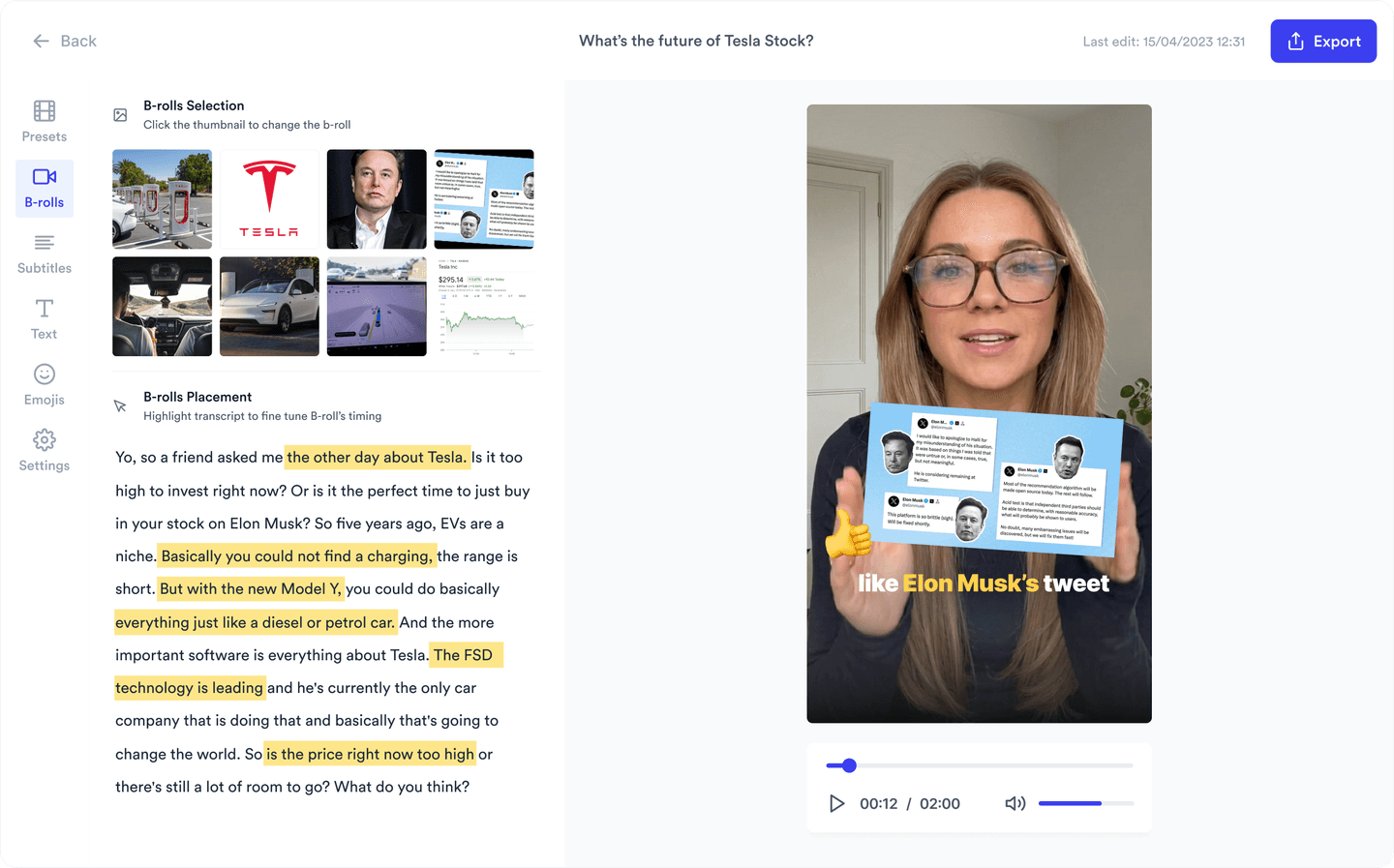
The edit is where a recording becomes a UGC video: dead space and mistakes trimmed, a tight hook, captions added, product B-roll and screenshots cut in, sometimes a split screen, and a version for each platform. Creators do this in a mobile editor, a desktop editor or an automated one; our guide to the best UGC video editors compares those approaches, and the best AI tools for UGC creators covers the rest of the workflow from research to publishing.
Deliver, or publish
Paid UGC is delivered as files, usually several cuts and aspect ratios, and the brand runs it. Organic UGC is posted. Creators who make UGC-style videos about their own business, coaches, consultants and founders talking about what they sell, sit in between: they brief themselves, record, edit and publish on a schedule. For that group, tools like Jupitrr automate the post-production step, placing B-roll, captions and sound effects on a talking-head recording automatically so the edit is a review rather than a build.
Already recorded your UGC video?
Upload a talking-head recording and Jupitrr adds B-roll, captions and sound effects automatically, then trims it into clips for each platform.
Frequently asked questions
UGC stands for user-generated content: content made by customers, fans or independent creators rather than by a brand’s in-house or agency production team. In video marketing the term now also covers paid creator content that is briefed by a brand but made to look and feel like a customer made it.
A UGC video is a video made by a user or independent creator, usually shot on a phone and spoken directly to camera, that shows a product in a personal, conversational way. It can be posted organically by a customer, commissioned from a UGC creator for the brand to use in its own channels and ads, or, increasingly, generated by AI in the same style.
Influencer marketing mainly buys reach: a creator with an audience posts about the brand to their own followers. UGC creator work mainly buys the creative asset: the brand receives the video and runs it in its own organic posts and paid ads, and the creator often never posts it. The two overlap, for example when a brand pays a creator for a video and then boosts the creator’s own post through TikTok Spark Ads or Meta partnership ads.
A UGC creator is someone brands pay to make customer-style videos for the brand’s own use. Unlike an influencer, they are not hired for their follower count; they are hired for the footage. Many UGC creators have small audiences or none, and deliver videos to the brand rather than posting them.
Strictly, no: nobody used the product on camera. In practice the term “AI UGC” is used by vendors to describe synthetic videos with an AI presenter made in the UGC style. It is best treated as its own category. Real creator UGC and AI-generated UGC solve different jobs, and platforms including TikTok and Meta require AI-generated content to be labelled.
When a creator posts paid content to their own audience, endorsement rules apply. In the United States the FTC’s Endorsement Guides require a clear and conspicuous disclosure of the brand relationship. When the brand runs the video in its own ad account, it is already presented as advertising. Check the rules for your market and platform.
Most UGC videos for TikTok, Reels and Shorts run between 15 and 60 seconds, with the hook in the first one to three seconds. Tutorials and reviews for product pages or YouTube can run longer. Brands usually specify length in the brief, and often ask for several cuts of the same recording.
From recording to ready to post
Jupitrr turns a talking-head recording into an edited, captioned video with B-roll, automatically.