By the Jupitrr team · Last updated August 2026
What Is B-Roll?
B-roll is the supporting footage layered over your main shot: the stock clips, charts, screen recordings and reaction visuals that appear while you keep talking. This guide covers what it is, the nine types modern creators actually use, and how much is too much.
The short answer
B-roll is any footage or visual in a video that is not the main shot. The main shot, called A-roll, carries the story: in most creator content, that is you talking to camera. B-roll is everything the editor cuts to while your voice keeps going, from a stock clip of a busy office to a chart, a screen recording or a GIF.
The names come from film editing, where primary footage lived on one roll of film and supporting footage on a second. The rolls are gone; the division of labor survives. A-roll makes the argument, B-roll supports it.
B-roll also solves a mechanical problem: hiding cuts. Every time you trim a mistake or tighten a pause in the main take, the frame jumps. Cover the cut with B-roll and the edit disappears, which is why even videos that could survive without supporting visuals usually carry some.
What B-roll actually does
The traditional definition, secondary footage that supports the primary footage, is accurate but incomplete. In modern short-form and educational content, creators reach for B-roll to do five distinct jobs:
- Explain: Charts, diagrams and screen recordings that make an idea easier to grasp than words alone.
- Visualize: Stock or generated footage that gives abstract subjects, such as burnout or growth, something to look like.
- Reference: Images of the people, companies and products you mention, so viewers see who and what you mean.
- Entertain: GIFs, reaction clips and pop-culture moments that add humor and keep the tone light.
- Build identity: Personal and lifestyle footage that makes the video recognizably yours.
Thinking in jobs rather than footage types is the practical skill: the question while editing is never "do I have enough B-roll?" but "does this moment need explaining, proving, showing or lightening?" For moment-by-moment examples, see our B-roll ideas for talking-head videos.
The nine types of B-roll creators use
Stock footage
The classic. When you talk about something abstract, such as burnout, growth, teamwork or freedom, stock footage gives the viewer something concrete to look at while you explain. It is the workhorse type for coaches, consultants and educators whose subject matter rarely sits in front of a camera.
People and brand references
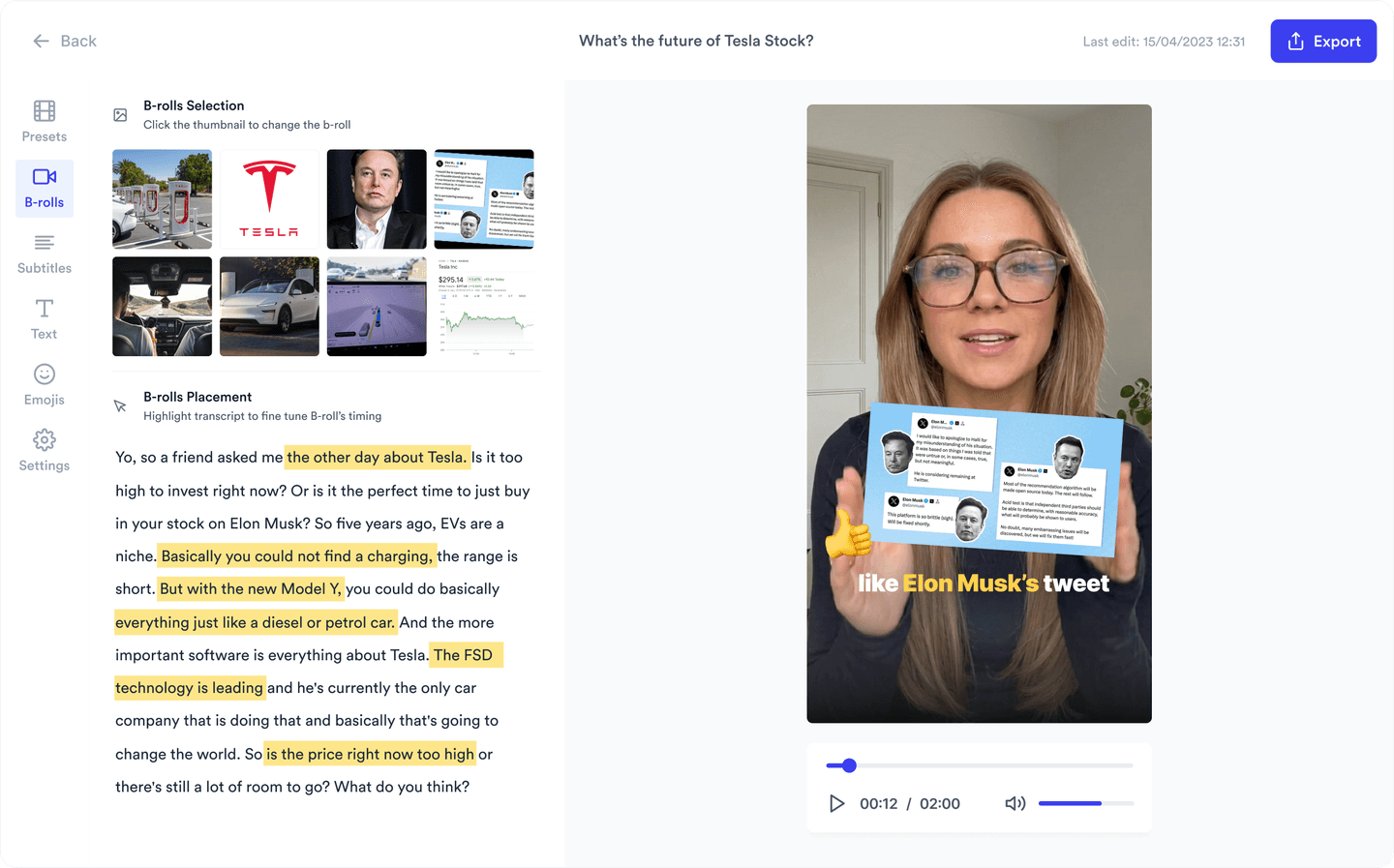
Mention a founder, a company or a product and viewers expect to see it. The manual version of this workflow is tedious: search images, download, upload into the editor, place and resize, once per reference.
Rights note: Images of people, logos and products are usually someone’s property. Usage rights depend on the source and context, so pull reference images from licensed or properly attributed sources rather than grabbing whatever an image search returns.
Charts and graphs
Statistics, trends, frameworks and before-and-after comparisons land harder as a visual than as a spoken number. Not cinematic B-roll in the traditional sense, but in modern educational content a chart does exactly the same job: supporting what the speaker is saying.
Illustrations and diagrams
Stick figures, simple sketches and visual metaphors excel at abstract ideas that neither footage nor charts capture, such as a story about two competing priorities or a framework with three moving parts. Simple beats polished here; clarity is the whole point.
Movie and pop-culture clips
A recognizable scene communicates emotion or humor in half a second because the audience already knows the reference.
Rights note: Film and TV clips are copyrighted, and reuse is not automatically permitted just because the clip is everywhere. Whether a specific use is allowed depends on the content, the platform and the context.
GIFs and reaction visuals
GIFs lighten the tone, add movement and give the viewer a beat of comic relief between dense points. They are especially at home in short-form social content, where a fully serious sixty seconds can feel flat.
Rights note: The same copyright caution applies: a GIF platform hosting a clip does not by itself grant you commercial rights to it.
Screen recordings
For anything involving software, websites or digital workflows, a screen recording is the most honest B-roll there is: the viewer watches the actual thing being described. Essential for tutorials, product walkthroughs and most business content about tools.
AI-generated visuals
Generative tools can produce footage of scenes that are hard or impossible to film: stylized, conceptual or fantastical shots. Used sparingly they cover real gaps. Used heavily they can backfire, because artifacts and inconsistency between clips read as artificial and can undercut trust in the speaker.
Personal and lifestyle footage
Walking outside, making coffee, working at a desk: footage of your actual life is the cheapest B-roll to capture and the only kind nobody else can use. In personal-brand content it does double duty, breaking up the talking head while making the video unmistakably yours.
| Type | Job | Best for |
|---|---|---|
| Stock footage | Visualize | Abstract concepts and scene-setting |
| People and brand references | Reference | Naming people, companies and products |
| Charts and graphs | Explain | Statistics, trends and comparisons |
| Illustrations and diagrams | Explain | Frameworks, stories and metaphors |
| Movie and pop-culture clips | Entertain | Instant emotional shorthand |
| GIFs and reaction visuals | Entertain | Humor and tone in short-form |
| Screen recordings | Explain | Software, websites and tutorials |
| AI-generated visuals | Visualize | Scenes that cannot be filmed |
| Personal and lifestyle footage | Build identity | Personal-brand authenticity |
How much B-roll is too much?
B-roll earns its place when it helps the viewer understand or believe the point being made. It overstays when it starts replacing the speaker instead of supporting them. In talking-head content, the face on camera is what viewers connect with; bury it under wall-to-wall cutaways and the video turns into a narrated slideshow.
In practice, effective short-form talking-head videos tend to cut to a supporting visual every few sentences for a few seconds at a time, returning to the speaker as the anchor. The common mistakes are consistent enough to list:
- Decorative B-roll that matches the vibe but not the sentence being spoken, which viewers register as filler.
- Clips that outstay the point: a four-second idea covered by twelve seconds of footage.
- Generic stock cliches, such as handshakes and typing close-ups, standing in for specific claims that deserved a chart or a screenshot.
- Mismatched visual quality, where a crisp A-roll cuts to muddy footage or an artifact-heavy generated clip.
- Hiding every single cut, when a visible jump cut is often the more energetic choice in short-form.
Where to get B-roll
There are four routes, and most creators end up mixing them.
Free stock libraries
Sites like Pexels, Pixabay and Mixkit offer free clips, most of them usable commercially without attribution under each site's licence. The trade is the workflow: search, preview, download, upload, place and resize, for every clip. Our guide to the best free B-roll footage websites compares the licensing fine print.
Paid stock and licensed footage
Getty Images, Storyblocks and similar libraries offer deeper catalogs and clearer commercial licensing, at subscription or per-clip prices. Our broader best B-roll tools guide covers where each fits.
Shoot it yourself
Screen recordings cost nothing and prove your point exactly, and lifestyle footage from your phone is the only B-roll nobody else can use. The limit is time and the range of subjects you can actually film.
Let AI match or generate it
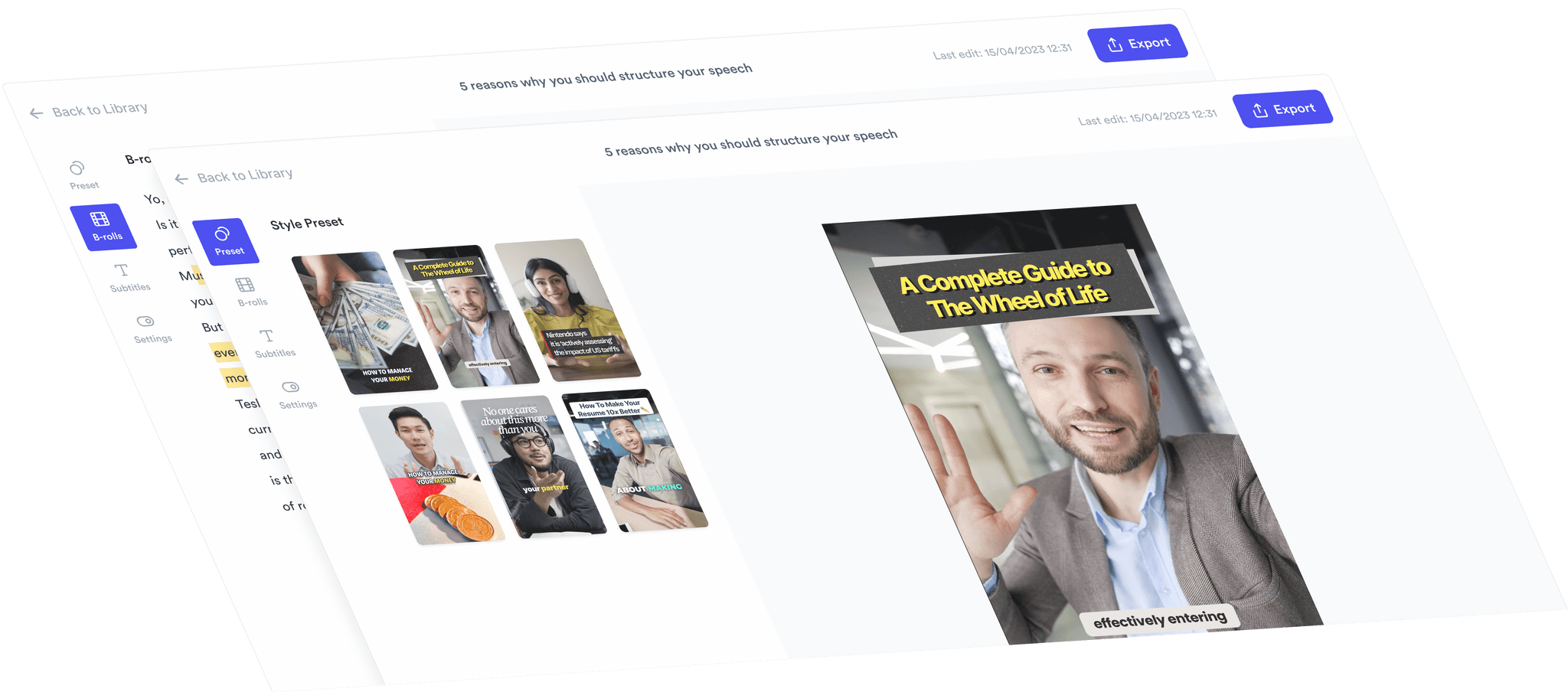
The newest route automates the search. Matching tools read your transcript and pull relevant existing footage; generative tools create new visuals from a prompt. Our best AI B-roll tools guide separates the approaches. Jupitrr sits in the matching camp: upload a talking-head video and its AI B-roll generator matches Getty-licensed footage, images and GIFs to the meaning of each sentence and places them in the edit before you open it, with every clip one-click swappable.
B-roll without the search
Upload a talking-head video and Jupitrr matches licensed footage to every point you make, placed automatically alongside subtitles and sound effects.
Frequently asked questions
B-roll is any footage or visual shown on screen that is not the main shot. In a talking-head video, the main shot (A-roll) is you speaking to camera; B-roll is everything cut in over it: stock clips, charts, screen recordings, images or GIFs that support, prove or illustrate what you are saying.
A-roll is the primary footage carrying the story, usually the speaker talking to camera. B-roll is the supporting material layered over or between A-roll moments. The audio almost always stays with the A-roll while B-roll covers the screen, which is also why B-roll is so useful for hiding cuts in the main take.
The term comes from film editing, where the primary footage was on one roll of film (the A roll) and secondary footage was on a second roll (the B roll) so editors could cut between them. The rolls are long gone, but the names stuck.
A useful rule is that B-roll should appear whenever it helps the viewer understand or believe the point, and never just to fill space. In practice many short-form talking-head videos cut to a supporting visual every few sentences, a few seconds at a time, keeping the speaker as the anchor. If viewers lose track of who is talking or why, there is too much.
Four main routes: free stock libraries like Pexels for downloadable clips, paid libraries like Getty Images or Storyblocks for licensed premium footage, self-shot footage and screen recordings for authenticity, and AI tools that match or generate B-roll automatically. Jupitrr takes the automatic route: it matches licensed footage to your transcript and places it in the edit for you.
Give every point a visual
Jupitrr matches licensed B-roll to what you say and places it in the edit for you.