Last updated August 2026
Opus Clip vs Jupitrr AI
Jupitrr AI picks up where Opus Clip leaves off, turning short-form clips into polished, published, and tracked organic content from one platform.
What makes Jupitrr AI different from Opus Clip?
We will be honest, Opus Clip is really good at what it does. If you have a two-hour podcast and need ten clips by tomorrow, it is hard to beat. Where it gets tricky is what happens next: the clips come out a bit raw, and you end up editing them somewhere else anyway. That somewhere else is often Jupitrr AI. Jupitrr AI clips long talking-head recordings too, and it finishes what it clips: B-rolls, subtitles, hooks, music, scheduling, tracking. If your source footage is talking-head, Jupitrr covers the whole job. If you clip podcasts, interviews, or footage without a speaker on camera, Opus Clip is still the specialist, and plenty of creators use both.
Opus Clip is good for
Chopping long podcasts and webinars into short clips
- Their Virality Score is genuinely useful for picking which clips are worth posting
- Auto-reframing handles the landscape-to-vertical crop really well, speaker tracking included
- Pro plan comes with a scheduler so you can auto-post straight from the tool
- Unlimited stock B-roll on Pro, which is nice if you go through a lot of clips
- You can set up brand templates with your logo, fonts, and colors so clips stay on-brand
Jupitrr AI is best for
Coaches and consultants publishing talking-head video consistently
- Scheduling, publishing, and analytics all live in one place
- AI video clipping cuts long talking-head recordings into fully edited shorts
- Purpose-built for talking-head video, so every feature is tuned for that
- Upload a clip and the AI adds B-rolls, subtitles, hook text, and music for you
- Premium Getty and Google images pulled in automatically
- Chat with Levio to tweak your edit like talking to a real editor
What editing looks like
See the difference between a timeline editor and an AI-powered platform.
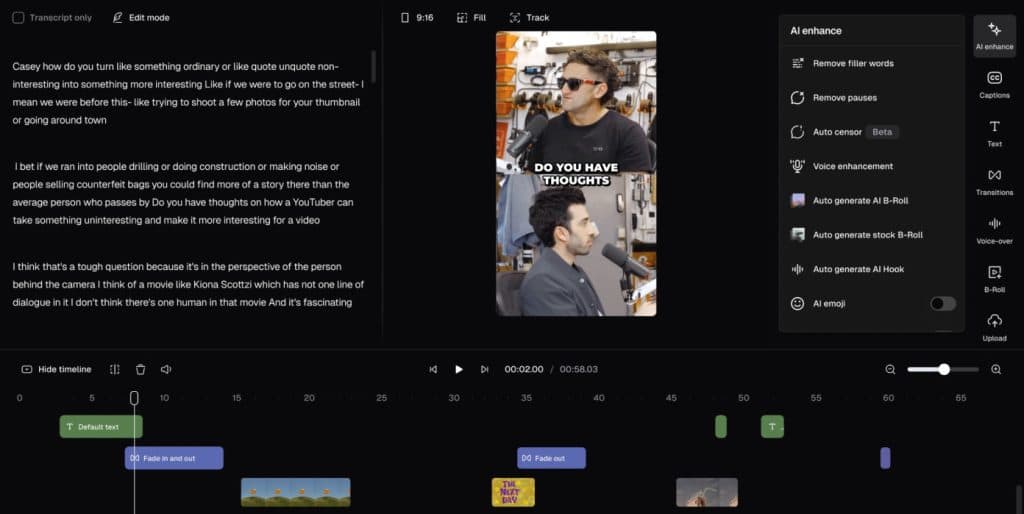
Opus Clip
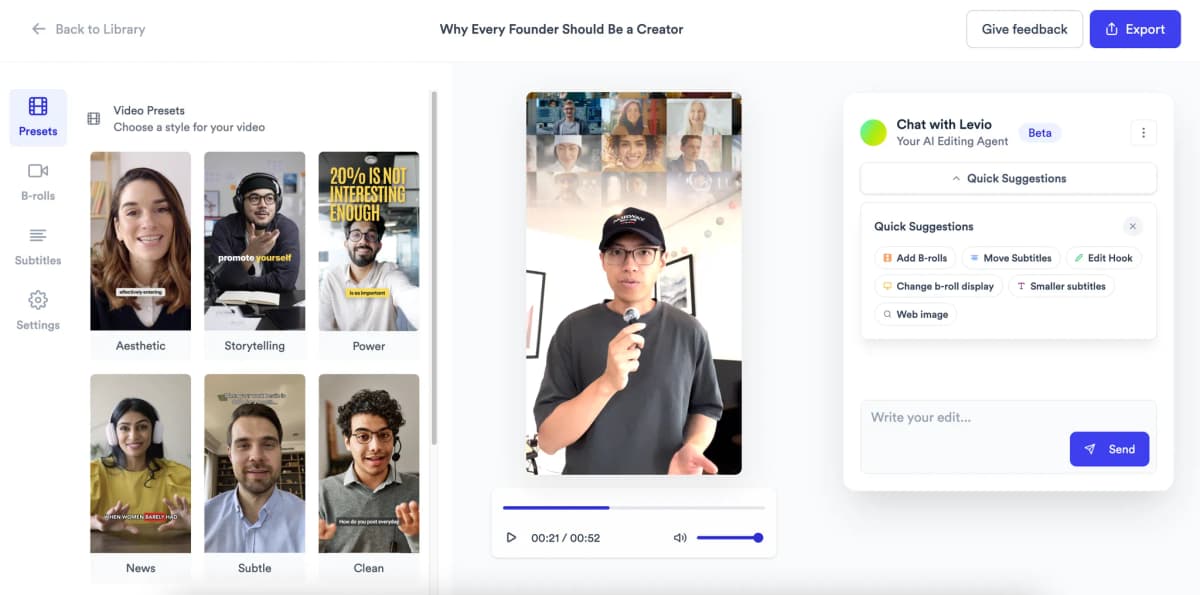
Jupitrr AI
Feature comparison
A detailed look at how Opus Clip and Jupitrr AI compare across key features.
Platform type
Research & Ideation
AI Scriptwriting
Primary use case
B-rolls and Sources
Automation level
Content Calendar & Scheduling
Analytics
Price
Try the sample video free, plans from $15/month
Helping you decide
No tool is perfect for everyone. Here is who we think each one is best for.
Solopreneurs
Go with Jupitrr (or both)
- Purpose-built for original short-form talking-head content
- Use Opus Clip too if you have long-form to repurpose
- Scheduling and analytics built in so you can track what works
Startups and B2B teams
Go with Jupitrr
- Add team members to co-work on scripts, editing, and analytics together
- Measure your video success across platforms from one dashboard
- Brand kit keeps every video consistent as the team scales
Content creators
Use both
- Opus Clip to extract the best clips from your long-form content
- Jupitrr to polish them with B-rolls, hooks, and subtitles
- Then schedule and publish directly from Jupitrr
Marketing agencies
Go with Jupitrr
- Separate workspaces to manage video per client
- One platform for editing, scheduling, and performance tracking
- Use Opus Clip alongside for clients with podcast content
Comparing more than two tools? Read our guide to the best OpusClip alternatives.
Frequently asked questions
Jupitrr AI is the better choice if you create original short-form content like talking-head videos. Opus Clip is designed for repurposing long-form content into short clips, not for enhancing or editing original short videos. More importantly, Jupitrr AI is a full marketing platform, it handles research, scripting, editing, publishing, and analytics, while Opus Clip only does clipping.
Yes, and many creators already do! Use Opus Clip to extract the best clips from your long-form content, then bring those clips into Jupitrr AI to enhance them with B-rolls, dynamic captions, hook text, and background music. From there, use Jupitrr AI's content calendar to schedule and publish them, and track performance, all from one platform.
If you already use Opus Clip to extract clips from long-form content but then need separate tools to enhance, schedule, and track those clips, Jupitrr AI picks up where clipping ends. It is built for coaches, consultants, and expertise-led creators who want to take raw clips and turn them into polished, published, and tracked content.
Opus Clip is great at clipping but the editing still requires manual fine-tuning after the clips come out. The B-roll, title, and hook text options are limited compared to dedicated editors, and at its core it is still primarily a clipping tool, there is no full editing, research, or scripting, and analytics only cover the clips it posts. The free plan is watermarked and projects expire in just 3 days, which can catch you off guard if you do not export quickly.
Jupitrr AI is focused on talking-head content. Its AI video clipping works on long talking-to-camera recordings; if you need to chop a multi-speaker podcast or footage without a speaker on camera, Opus Clip handles that range better. Jupitrr is also not the right tool if you need a general-purpose timeline editor.
Yes, for talking-head recordings. Upload a long talking-to-camera video and AI Video Clipping cuts short-form clips and generates the full edit with B-rolls, subtitles, and hooks. Opus Clip remains the specialist for clipping any kind of footage, podcasts, interviews, screen shares, so some creators still use both: Opus Clip for mixed long-form content, Jupitrr AI to clip and finish talking-head recordings, then schedule and track everything.
Opus Clip has a free plan with watermarks (60 min/month), Starter at $15/month for 150 minutes, and Pro at $29/month for 300 minutes with a scheduler and unlimited B-roll. Jupitrr AI has no free plan (you can try a sample video free), with Starter at $15, Pro at $33 and Team at $89 per month billed annually, plus a 7-day money-back guarantee. The two are similarly priced at entry level, but Jupitrr covers the full workflow, editing, clipping, scheduling, and analytics, rather than clipping alone.