By the Jupitrr team · Last updated September 2026

Best Video Tools for Course Creators

This guide is about producing course video, not hosting it: platforms like Kajabi and Teachable store and sell lessons, but something still has to record and edit them, plus the promos that sell the course. We compare seven production tools by lesson type: screen tutorials, talking-head lessons, slides, avatar lessons and promotional content.

Top picks at a glance

The strongest video tools for course creators are Camtasia, ScreenFlow, Descript, Jupitrr AI, Synthesia, Canva and Loom. The right one depends on what your lessons are made of: your screen, your face, your slides or an avatar.

How we chose: We compared each tool on course production jobs: lesson recording, screen capture, talking-head editing, captions, slide-based lessons and turning lessons into promotional content. Hosting platforms were excluded on purpose. Capability claims were checked against vendor sites in September 2026. Tools are matched to lesson types rather than ranked from first to last.

How the tools compare

ToolLesson typeScreen recordingTalking-head lessonsCaptionsPromos and repurposingPricing
Camtasia logoCamtasiaScreen tutorials with callouts and quizzesPurpose-built, with cursor effectsCamera overlayManual and AI-assistedSubscription from $179/user/yr
ScreenFlow logoScreenFlowMac screen tutorialsScreen, camera and iOS device captureCamera overlayClosed captions supported$199 one-time
Descript logoDescriptTalking-head and screen lessons, hand-editedBuilt inStrong, edited via transcriptAutomatic transcriptionClip generation from lessonsFree plan; from $16/mo billed annually
Jupitrr AI logoJupitrr AITalking-head lessons, edited automaticallyFirst edit generated on upload, with B-rollAutomatic, 54+ languagesAI clipping, scheduling and analytics$18/mo billed annually. Free plan
Synthesia logoSynthesiaAvatar lessons from a scriptScreen recorder built inAI avatar instead of youGenerated with the videoOne-click translationFree plan; Starter $18/mo billed annually
Canva logoCanvaSlide-based lessons and visualsBasic screen and camera recorderPresent-and-record over slidesAuto captionsResize across formatsFree plan; Pro subscription
Loom logoLoomQuick informal lessons and feedbackInstant screen and cameraCamera bubbleAuto transcripts in 50+ languagesFree plan; Business $18/user/mo

Capability and pricing claims checked against vendor sites in September 2026. Details vary by plan.

The best options in detail

Camtasia logoCamtasiaBest for polished screen-recorded lessons with quizzes

For screen-first courses (software training, technical walkthroughs) Camtasia remains the deepest tool: screen, camera and audio on separate tracks, with the callouts, zooms and cursor effects that make a tutorial followable, plus quizzing and interactivity for actual courseware.

Recent versions added text-based editing, AI voiceover and translation. Note the pricing change if you last looked years ago: it moved from one-time licenses to an annual subscription.

Strengths

  • Purpose-built screen recording with camera overlay
  • Callouts, zooms and cursor effects for followable tutorials
  • Quizzing and interactivity for courseware
  • Multitrack timeline for precise lesson editing
  • Windows and Mac, with a long training-video pedigree

Tradeoff

A real learning curve, subscription-only pricing now, and overkill when lessons are a person talking rather than a screen.

Pricing: Subscription from $179/user/yr (Essentials). Free watermarked tier. Perpetual licenses discontinued.

Best suited for: Course creators whose lessons live on the screen: software, tools and technical workflows.

Visit Camtasia's website

ScreenFlow logoScreenFlowBest for Mac screen tutorials at a one-time price

ScreenFlow is the Mac answer to Camtasia and the last notable holdout on one-time pricing: $199 buys screen, camera, mic and iOS-device capture with a genuine timeline editor, transitions, text animation and closed captions.

It is Mac-only and still actively developed, though it has largely sat out the AI feature race. For a creator who records lessons the same way every week, that predictability is part of the appeal.

Strengths

  • One-time purchase instead of a subscription
  • Records screen, camera, mic and iOS devices
  • Real timeline editing with transitions and text animation
  • Closed captions supported
  • Actively maintained and Apple Silicon native

Tradeoff

Mac-only, no meaningful AI assistance, and editing is fully manual, so lesson production time stays proportional to lesson length.

Pricing: $199 one-time. Optional stock library subscription.

Best suited for: Mac-based course creators who want capable screen-lesson production without recurring fees.

Visit ScreenFlow's website

Descript logoDescriptBest for editing long lessons in the transcript

Course lessons are long, and mostly talk, which is exactly what transcript editing is for. Descript transcribes a lesson and you tighten it by deleting words: tangents, false starts and filler disappear from the video as you cut them from the text.

It records screen and camera itself, Studio Sound rescues home-office audio, and its clip tools cut promo moments from lessons. The trade is that you are still the editor; it makes editing faster, not optional.

Strengths

  • Edit hour-long lessons by editing the transcript
  • Filler-word and silence removal in one click
  • Studio Sound cleans up home-studio audio
  • Screen recording for mixed screen-and-face lessons
  • Clip generation pulls promo moments from lessons

Tradeoff

Hands-on by design: every lesson still gets an editing pass, and AI features consume monthly credits.

Pricing: $16/mo billed annually (Hobbyist); the fuller Creator plan is $24/mo. Free plan available.

Best suited for: Course creators who want tight, hand-finished lessons and think in words rather than timelines.

Visit Descript's website

Jupitrr AI logoJupitrr AIBest for talking-head lessons and recurring promotional content

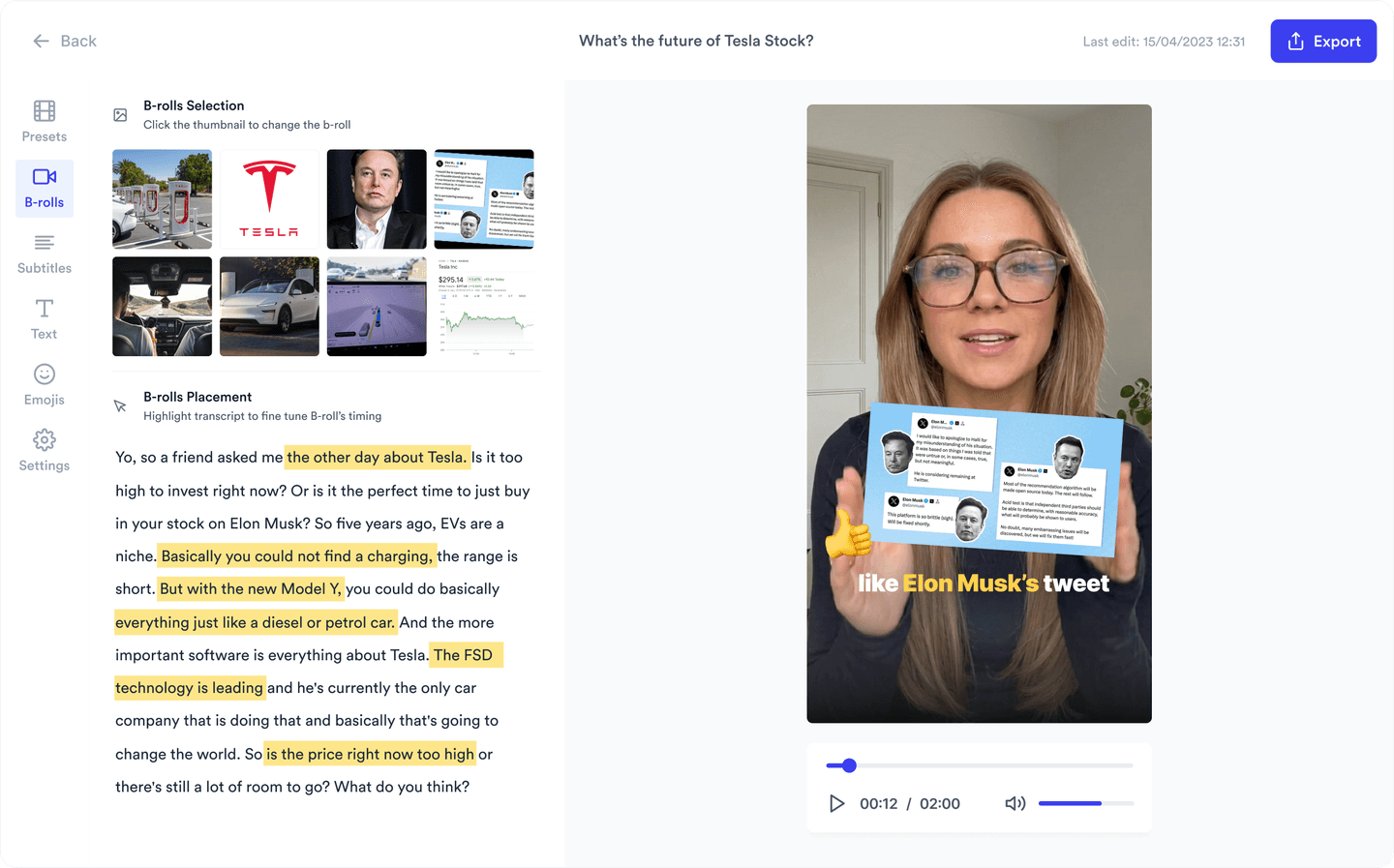
When lessons are you teaching to camera, Jupitrr AI removes the editing pass entirely: upload the recording and the AI video editor returns it with Getty-licensed B-roll illustrating your points, subtitles in 54+ languages and sound effects placed automatically. The AI script writer and teleprompter cover the steps before recording.

It also solves the job course creators neglect: selling the course. AI clipping cuts lessons into short-form promos, and scheduling and analytics keep them shipping weekly. It does not record your screen, so software-heavy lessons pair it with Camtasia or ScreenFlow.

Strengths

  • Talking-head lessons come back pre-edited: B-roll, subtitles and sound effects on upload
  • Subtitles in 54+ languages make lessons accessible by default
  • AI clipping turns lessons into a stream of course promos
  • Scripting, teleprompter, scheduling and analytics in the same workflow
  • No timeline and no editing experience required

Tradeoff

No screen recording, so tutorial-style lessons need a screen tool alongside it; the automation is built for talking-head footage.

Pricing: $18/mo billed annually. Free plan available.

Best suited for: Course creators who teach to camera and need marketing content to keep selling the course.

Teach the lesson. Skip the edit.

Upload a talking-head lesson and get it back with B-roll, subtitles and sound effects placed automatically, then clip it into promos that sell the course.

Jupitrr AI editor showing an automatically edited talking-head video

Synthesia logoSynthesiaBest for avatar lessons and multilingual versions

Synthesia produces lessons without a camera: write the script and an AI avatar teaches it, with one-click translation into 160+ languages. For curriculum that changes often, updating a lesson means editing a script rather than re-recording, and LMS integration slots it into corporate training pipelines.

The format suits procedural and compliance-style teaching more than creator-led courses, where students are usually buying the teacher as much as the material.

Strengths

  • Lessons from a script, no recording setup
  • One-click translation with lip-sync for multilingual courses
  • Script edits replace re-recording when content changes
  • Screen recorder and doc-to-video for source material
  • SCORM and LMS integration for training programs

Tradeoff

An avatar cannot replace a teacher students chose, and entry-plan minute caps are tight for a full curriculum.

Pricing: Free plan with monthly minute limits. Starter $18/mo billed annually ($29 monthly).

Best suited for: Teams producing procedural training at volume, or courses that must exist in many languages.

Visit Synthesia's website

Canva logoCanvaBest for slide-based lessons and course visuals

A course is more than its lessons: slides, workbooks, thumbnails and social assets all need making. Canva covers that whole design layer, and its present-and-record mode turns a slide deck into a narrated lesson with your camera in the corner, a legitimate production path for slide-led teaching.

Its dedicated AI course features can even assemble slides and video into structured learning content. The video editing itself stays shallow; it is the design layer of a course stack, not the edit suite.

Strengths

  • Present-and-record turns slide decks into narrated lessons
  • One workspace for slides, workbooks, thumbnails and promos
  • Brand kit keeps every course asset consistent
  • Auto captions on recorded video
  • Free plan covers real production

Tradeoff

Shallow video editing and template-recognizable output: lessons built on footage rather than slides need a real editor.

Pricing: Free plan available; Pro subscription adds premium assets and AI features.

Best suited for: Course creators who teach from slides and want every course asset in one branded workspace.

Visit Canva's website

Loom logoLoomBest for quick informal lessons and student feedback

Not every course video deserves production: answering a cohort question, reviewing a student's work, adding a quick update to a module. Loom is the fastest path for those: screen and camera, one click, share the link, with automatic transcripts and AI summaries.

Some creators run entire informal cohort courses on it. As the main production tool for a flagship course it is too light; as the speed layer next to one, it earns its slot.

Strengths

  • Instant screen-and-camera recording with a shareable link
  • Automatic transcripts and captions in 50+ languages
  • Viewer insights show which students watched
  • AI titles, summaries and chapters
  • Free plan covers light use

Tradeoff

Minimal editing and a five-minute cap on the free plan: it is a communication tool sitting beside your production tools, not one of them.

Pricing: Free plan (25 videos, 5-minute cap). Business $18/user/mo; the AI tier is $24/user/mo.

Best suited for: Course creators running cohorts who need fast, personal video between polished lessons.

Visit Loom's website

Other tools we considered

  • Riverside: the right tool if your course includes guest interviews or live cohort sessions; for solo lesson production it overlaps Descript and Jupitrr.
  • VEED: a capable browser editor for subtitling and resizing lesson clips, but each of its jobs here is covered by a stronger pick.
  • Kajabi, Teachable and other course platforms: they host and sell the course; none of them solve recording and editing the lessons, which is the question this page answers.

How to choose the right tool

Camtasia logo

Your lessons are screen-first and need callouts, zooms and quizzes.

Choose Camtasia
ScreenFlow logo

You are on a Mac and want screen-lesson production for a one-time price.

Choose ScreenFlow
Descript logo

You want hand-edited lessons and would rather cut words than clips.

Choose Descript
Jupitrr AI logo

You teach to camera and want lessons and course promos produced automatically.

Choose Jupitrr AI
Synthesia logo

You need avatar-led or multilingual training video at volume.

Choose Synthesia
Canva logo

You teach from slides and want the whole course design layer in one place.

Choose Canva
Loom logo

You need fast, informal video for cohorts and feedback between real lessons.

Choose Loom

Frequently asked questions

Usually two: a lesson tool matched to your teaching format and something for promotion. Screen-first teachers pair Camtasia or ScreenFlow with a promo workflow; talking-head teachers can use Jupitrr AI for both, since it edits lessons automatically and clips them into promotional short-form. Hosting platforms like Kajabi handle delivery, not production.

Jupitrr AI is the strongest automated option: upload a lesson and it returns edited, with B-roll matched to your transcript, subtitles in 54+ languages and sound effects placed automatically. Descript is the best hands-on alternative, editing the lesson by editing its transcript. Which one fits depends on whether you want an editing pass at all.

The most efficient source is the course itself: strong lesson moments become short-form promos. Jupitrr AI does this in one workflow, clipping talking-head lessons into captioned vertical clips and scheduling them, with analytics on what converts. OpusClip-style clipping tools do the same job if your lessons are produced elsewhere.

Probably not. Camtasia earns its price when lessons depend on screen recording with callouts and quizzes. If your lessons are you teaching to camera, an automated editor like Jupitrr AI or a transcript editor like Descript produces better results faster, and if you teach from slides, the present-and-record mode in Canva covers it.

More teaching, less producing

Jupitrr AI edits your talking-head lessons automatically and turns them into promos that sell the course.

Jupitrr AI dashboard