By the Jupitrr team · Last updated October 2026
Royalty-Free vs Copyright-Free
Royalty-free means you pay for a license once, or get it free, and reuse the work without per-use royalties, while the creator keeps the copyright. Copyright-free means no copyright applies at all. This guide explains both, plus Creative Commons and free stock licenses, for commercial video, B-roll, images and music.
The difference between royalty-free and copyright-free
Royalty-free is a way of paying for a license. Copyright-free is a legal status. A royalty-free clip from Getty Images is still owned by Getty Images or its contributor; you bought permission to use it on certain terms. A copyright-free image, such as a public domain photo or a file its owner dedicated with CC0, needs no license at all.
Most of what creators download sits in a third bucket: free stock sites like Pexels, Pixabay, Mixkit and Coverr. Their footage is free to use, often commercially and without credit, but it is not copyright-free. It comes with each site's own license and its own list of things you cannot do.
| Model | Cost | Copyright | Commercial use | Credit needed | Example sources |
|---|---|---|---|---|---|
| Royalty-free | Free or paid, once | Yes, owner keeps it | Usually, check terms | Depends on license | Getty Images, iStock |
| Rights-managed | Paid per use | Yes, owner keeps it | Only as licensed | Depends on license | Getty Images rights-ready |
| Public domain | Free | No copyright | Yes | No | US federal works, expired works |
| CC0 | Free | Waived by owner | Yes | No | Files marked CC0 |
| CC BY family | Free | Yes, owner keeps it | Varies (NC bans it) | Yes | Wikimedia Commons, Flickr |
| Custom free license | Free | Yes, owner keeps it | Yes, with limits | No | Pexels, Pixabay, Mixkit, Coverr |
Not legal advice: This is general information, not legal advice. License terms change, and the facts here were checked against each source in October 2026. For high-stakes uses such as national ad campaigns, read the current license and talk to a lawyer.
What royalty-free means, and why it can cost money
A royalty is a payment made each time a work is used. Royalty-free removes that recurring payment: you get a license, usually for a one-time fee or through a subscription, and reuse the content without paying again. Getty Images' license defines it as a fee paid once with no additional royalties if the content is reused, and its FAQ says a royalty-free license lets you use the file in almost any way, as often as you want.
So royalty-free does not mean free. Getty Images, iStock and similar libraries sell royalty-free content. Free libraries are also royalty-free, they just set the one-time fee at zero. In both cases the copyright stays with the creator or library, and the license still sets limits.
When royalty-free licensing fits
- Commercial projects such as ads, product pages and packaging, where you reuse the same asset across many placements.
- Websites and blogs, where an image stays live indefinitely.
- Videos, presentations and online courses, including B-roll cut into talking-head content.
- Print runs such as brochures and catalogs, where per-copy royalties would add up.
- Social media posts, covers and channel art.
What to check before you rely on it
Read the license for the specific file: whether it allows commercial use, whether it caps print runs or audience size, whether it is marked editorial only, and whether a model or property release is on file. Royalty-free tells you how you pay, not what you may do.
Copyright-free, public domain and CC0 explained
In the US, a work is protected by copyright the moment it is created and fixed in a tangible form, according to the US Copyright Office. No registration or notice is needed: the Office notes that a copyright notice was once required but is now optional. A photo with no copyright line is not copyright-free for that reason alone.
Public domain
The Copyright Office defines a work as in the public domain if it is no longer under copyright protection or failed to meet the requirements for it. That includes works whose copyright expired and material copyright never protects, such as works created by the US federal government. Public domain works can be used without permission from the former owner.
CC0
CC0 is a tool from Creative Commons that lets an owner waive all copyright and related rights to the fullest extent the law allows. CC0 works can be copied, modified and redistributed for any purpose, commercial included, with no attribution required. Creative Commons is explicit that CC0 does not waive trademark or patent rights, or the publicity and privacy rights of other people, so a CC0 photo of a person or a logo still carries those risks.
When copyright-free content fits
Public domain and CC0 material suits personal projects, education, non-profits, open-source projects and derivative works, and it is equally usable in commercial work. The trade-off is quality and verification: collections vary, and a file is only copyright-free if the source is reliable about its status. For a deeper look at stock imagery, read are stock photos copyrighted?
Creative Commons licenses and commercial use
Creative Commons licenses keep the copyright with the creator and grant you permissions on conditions. Every license except CC0 requires attribution. NC means non-commercial only. ND means you can share the work only in unadapted form, which rules out cutting or reframing a clip. SA means anything you build from it must carry the same or a compatible license. The summaries below follow creativecommons.org.
| License | Commercial use | Credit needed | Modify | Share-alike | Example sources |
|---|---|---|---|---|---|
| CC0 | Yes | No | Yes | No | Files marked CC0 |
| CC BY | Yes | Yes | Yes | No | Wikimedia Commons, Flickr, YouTube |
| CC BY-SA | Yes | Yes | Yes | Yes | Wikimedia Commons |
| CC BY-ND | Yes | Yes | No | No | Flickr (per file) |
| CC BY-NC | No | Yes | Yes | No | Flickr, Vimeo (per file) |
| CC BY-NC-SA | No | Yes | Yes | Yes | Flickr, Vimeo (per file) |
| CC BY-NC-ND | No | Yes | No | No | Flickr, Vimeo (per file) |
Platforms like Wikimedia Commons, Flickr and Vimeo host files under several of these licenses, so the license is set per file, not per site. For video, the practical rule is: CC0, CC BY and CC BY-SA can go into commercial videos with the right credit; any NC license cannot; and ND makes a clip hard to use as B-roll at all.
Free stock licenses: Pexels, Pixabay, Mixkit, Coverr and Unsplash
The big free libraries are not public domain and not Creative Commons. Each uses its own license, which generally allows free commercial use without credit, then lists specific exclusions. These are the terms as each site states them, checked in October 2026.
Pexels license
Allows: Free use of photos and videos, with modification allowed and attribution optional.
Forbids: Showing identifiable people in a bad or offensive light, selling unaltered copies (for example as posters or prints), implying endorsement by people or brands shown, redistributing on other stock or wallpaper platforms, and using the content as part of a trademark or business name. Read the Pexels license.
Pixabay license
Allows: Free use without attribution, including modifying content into new works.
Forbids: Selling or distributing content on a standalone basis, commercial use of content showing recognizable trademarks, logos or brands (particularly on merchandise), immoral, illegal or misleading use (especially with recognizable people), and use in trademarks or business names. Pixabay also notes some content may carry additional third-party rights you are responsible for checking. Read the Pixabay license.
Mixkit license
Allows: Clips under the Stock Video Free License can be used in commercial and personal projects, such as YouTube videos, social media marketing and online ads, with no attribution required.
Forbids: Clips under the Stock Video Restricted License are for personal, non-commercial projects only. On both licenses, you cannot sell copies without altering them or make the items available to third parties as they are. Check which license each clip carries before you download. Read the Mixkit license.
Coverr license
Allows: Commercial and non-commercial use of its videos and music at no cost, with modification allowed and attribution optional.
Forbids: Selling or redistributing the videos, building a similar or competing service, and using the content to train AI models or as part of a dataset. Coverr states it obtains model releases for people but does not provide them to users, and holds no releases for brands, trademarks, identifiable properties or landmarks. Read the Coverr license.
Unsplash license
Allows: Free download and use for commercial and non-commercial purposes, with no permission needed and attribution optional.
Forbids: Selling images without significant modification, and compiling images to replicate a similar or competing service. The Unsplash License is its own license, not CC0. Read the Unsplash license.
The pattern across all five: use is free and credit is optional, but reselling unaltered files or feeding them into a rival library is off limits. Pexels and Pixabay also bar using content in a trademark or business name, and none of the five licenses grants you releases for the people, brands or landmarks shown.
Can I use it on monetized videos, products I sell, or ads?
These are the three questions creators ask most about a clip or image. The table answers them per license, as each license states it in October 2026. Products you sell means merchandise, prints, templates, courses or other goods where the content is part of what the buyer pays for.
| License | Monetized videos | Ads | Products you sell | Credit | Watch out for |
|---|---|---|---|---|---|
| Public domain / CC0 | Yes | Yes | Yes | No | Trademarks and people’s publicity rights still apply |
| CC BY | Yes, with credit | Yes, with credit | Yes, with credit | Yes | Publicity and trademark rights not licensed |
| CC BY-NC | Unclear, ask the creator | No | No | Yes | Commercial use needs the creator’s permission |
| Pexels | Yes | Yes | Only if modified | No | No implied endorsement by people or brands shown |
| Pixabay | Yes | Yes, no visible brands | Only if not standalone | No | No brands or logos on goods you sell |
| Mixkit Free | Yes | Yes | Only if altered and combined | No | Restricted License clips: no ads or monetized YouTube |
| Coverr | Yes | Yes | No reselling clips; merch not addressed | No | Logos and private property need separate permission |
| Envato | Yes | Yes | Only with added value; no print-on-demand | No | One license per project |
| Getty Images (royalty-free) | Yes | Yes, not editorial | No on-demand products or resale templates | Video: when other credits run | Editorial-only clips; sensitive-use disclaimer |
| iStock standard | Yes | Yes, not editorial | Extended license | Video: yes, if feasible | 500,000 print copies max; sensitive-use disclaimer |
| Storyblocks | Yes | Online yes; TV needs Business | Inside finished work; no on-demand | No | Projects must be finished while subscribed |
Monetized videos
Earning from YouTube, TikTok or Instagram monetization is commercial use. Any license that allows commercial use covers it, which rules out Mixkit Restricted License clips, whose license names monetized YouTube videos as not allowed. Creative Commons NC means not primarily intended for commercial advantage or monetary compensation, and Creative Commons acknowledges gray areas, so ask the creator before monetizing NC content.
Ads
An ad is commercial use too, but it adds risks a regular video does not. A person or logo on screen can read as an endorsement, which Pexels forbids and which releases exist to cover. Editorial-only content is barred from advertising on Getty Images and iStock, both require a disclaimer when models appear next to unflattering or controversial subjects, and TV or OTT placements can need a higher license tier, as with Storyblocks Business.
Products you sell
Merchandise is where free licenses are strictest, because the clip or image itself becomes the product. Pexels, Pixabay and Mixkit all bar selling content unaltered, and Mixkit says printing an item on a mug or shirt is not enough alteration. Paid libraries charge more for it: iStock's standard license bans goods for resale where the content is the main value unless you buy an extended license, and Getty Images, Envato and Storyblocks bar on-demand or print-on-demand products. Sources: Pexels, Pixabay, Mixkit user terms, Coverr, Envato, Getty Images, iStock and Storyblocks.
Rights-managed and editorial-only content
Rights-managed (rights-ready)
Rights-managed licenses are priced for a specific use. Getty Images' FAQ describes its rights-ready licenses as based on how, where and for how long you plan to use the content, with a new license needed for a new project. That suits a single campaign with a known placement, and fits poorly with evergreen social videos.
Editorial use only
Editorial content covers news, events and public figures, and usually comes without model or property releases. Getty Images' license says you may not use content marked editorial for any commercial, promotional, advertorial, endorsement or advertising purpose without authorization. A clip of a product launch or a celebrity at an event may be fine in a news commentary video and off limits in a sponsored post or ad.
Can I use it commercially? A nine-point checklist
Commercial use covers more than ads: client work, sponsored posts, monetized YouTube videos and anything promoting a business usually count. Run each asset in a commercial video through these checks.
- 1. Read the license for commercial use: Check the license on the exact file, not the site. Some libraries, such as Mixkit, carry a free and a restricted license side by side, and Creative Commons NC files forbid commercial use outright.
- 2. Check for model and property releases: A copyright license covers the photo or clip, not always the people or private property in it. Getty Images, for example, warrants privacy and publicity rights for royalty-free creative content used as delivered, but for rights-ready content only where it says a release was obtained, and editorial content generally has no releases.
- 3. Watch for logos, trademarks and products: Trademark rights sit outside copyright. CC0 does not waive trademark rights, Pixabay bars commercial use of content with recognizable brands in relation to goods and services, and Coverr holds no releases for brands or landmarks.
- 4. Do not imply endorsement by recognizable people: People in stock footage have publicity and privacy rights. Pexels forbids implying that people or brands shown endorse your product, and CC0 does not waive anyone else’s publicity or privacy rights.
- 5. Skip editorial-only clips in promotional videos: Content marked editorial usually has no releases. Getty Images’ license bars it from commercial, promotional, advertorial, endorsement and advertising uses unless separately cleared.
- 6. Treat music as its own license: A clip’s video license does not automatically cover a song playing in it, and the music bed you add to your edit needs its own license. Getty Images’ royalty-free warranty covers audio that is part of a clip unless noted otherwise; free sites rarely say, so mute audio you have not licensed.
- 7. Expect YouTube Content ID claims: Content ID matches uploads against files submitted by copyright owners, and a match can block the video, monetize it for the claimant or track it. Licensed footage can still be claimed, so keep proof ready to dispute.
- 8. Know the status of AI-generated footage: The US Copyright Office concluded in January 2025 that AI outputs are protected only where a human determined sufficient expressive elements, and that prompts alone are not enough. Purely generated clips may not be protectable, and the tool’s terms still govern use.
- 9. Keep a license record: Save the license page, the file URL, the download date and any invoice or license certificate for every asset in a published video. If a claim or takedown arrives, that record is what you show.
Sources: the Getty Images license agreement, YouTube Help on how Content ID works and the US Copyright Office's Part 2 report on copyrightability.
Are stock photos and Getty Images copyright free?
Are stock images copyrighted?
Yes, almost always. Stock libraries license copyrighted work; they do not remove the copyright. That holds for free sites too: Pexels, Pixabay and Unsplash grant broad free licenses, but the photographers keep their rights. Stock photos are not public domain unless the specific file is marked public domain or CC0. Our guide to whether stock photos are copyrighted goes deeper.
Is Getty Images copyright free?
No. Getty Images' license states that all licensed content is owned by Getty Images or its content suppliers, with all rights not expressly granted reserved. Its FAQ says you need to buy a license to use images found on gettyimages.com. The one free route is an embed feature for non-commercial websites, which does not extend to commercial use or to downloading files into your own videos. See how to get Getty Images for free for the legitimate options.
Where to get B-roll you can use commercially
For commercial videos, the cleanest sources are paid libraries with royalty-free licenses and clear release information, free libraries whose license allows commercial use, and footage you shoot yourself. We compare the options in royalty-free B-roll for commercial use and the best free B-roll footage websites. If you are short on shot ideas rather than sources, start with B-roll ideas for talking-head videos.
How Jupitrr handles B-roll licensing
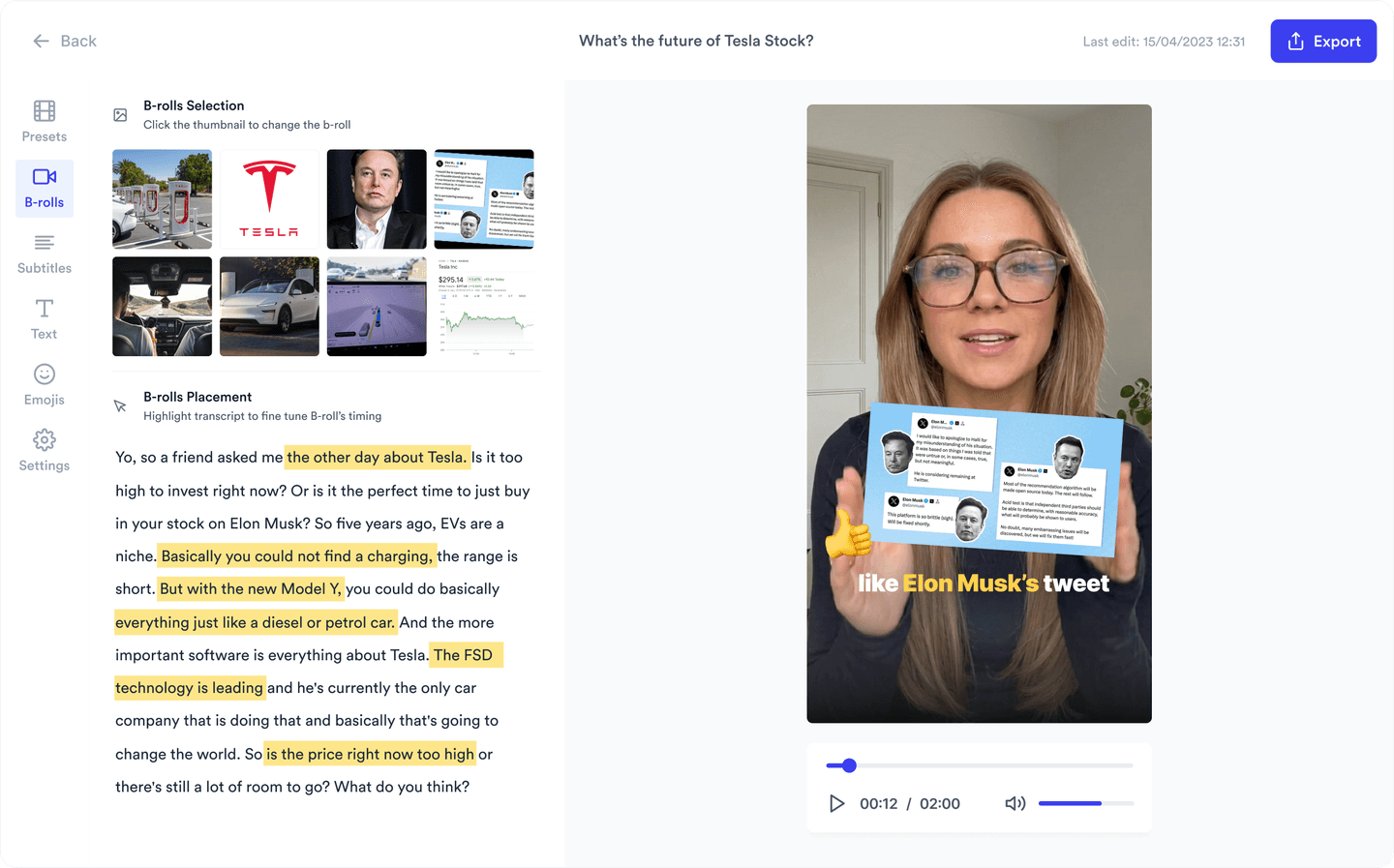
Jupitrr reads your transcript and places matched B-roll for each point, so there is no blank timeline to start: Jupitrr brings you the first cut. Its AI B-roll generator places clips from Getty Images and iStock (on paid plans), Pexels and web images. Jupitrr's terms say it does not guarantee that B-roll is free of usage rights and that you are responsible for verifying licensing for your use, so check each clip's license for monetization, ads or products you sell; web images need their rights confirmed. No free plan; try a sample video free. From $15/mo billed annually, 7-day money-back guarantee.
B-roll matched to what you say
Upload a talking-head video and Jupitrr places Getty Images, iStock and Pexels B-roll against your transcript, ready to swap or trim.
Frequently asked questions
Royalty-free means you pay for a license once, or get it free, and then use the content repeatedly without paying a royalty each time. Getty Images’ license puts it this way: the license fee is paid once and there is no need to pay additional royalties if the content is reused. The creator or library still owns the copyright, and the license terms still limit how you can use it.
No. Royalty-free is a licensing model: the work is still under copyright and you use it under a license, which may cost money. Copyright-free usually means the work is in the public domain or its owner waived copyright with CC0, so no license is needed at all. Many free stock sites are neither: they use their own custom licenses.
Copyright-free means no copyright restricts the work, so anyone can use it without permission or payment. That covers public domain works, which the US Copyright Office defines as works no longer under copyright protection or that failed to meet its requirements, and works whose owner waived copyright with CC0. Other rights, such as trademark or a person’s publicity rights, can still apply.
Usually not. Most stock images are copyrighted, and the library grants you a license to use them. Free sites like Pexels, Pixabay and Unsplash let you use images without paying or crediting, but under their own licenses with restrictions, such as not reselling unaltered copies. Only public domain or CC0 images are truly copyright free.
No. Getty Images’ license states that all licensed content is owned by Getty Images or its content suppliers. You need to buy a license to use images from gettyimages.com, with one exception: a free embed feature for non-commercial websites, which does not cover commercial use.
Generally no. Stock photos from libraries such as Getty Images, iStock, Pexels and Pixabay are copyrighted and licensed to you. A stock photo is only public domain if its copyright has expired, it was never protected (such as works by the US federal government) or its owner dedicated it with CC0.
Not automatically. Royalty-free describes how you pay, not what you may do. Many royalty-free licenses allow commercial use, but they can still exclude uses such as reselling, trademarks or sensitive subjects, and editorial-only images cannot be used commercially. Read the license on the specific file before using it in ads, client work or monetized videos.
Yes, when you follow the license that comes with them. Paid stock is legal to use once you have bought the right license for your use; free stock is legal under the site’s license terms. Using a stock photo without a license, or outside its terms, such as editorial content in an ad, can be copyright infringement.
Yes, when the clip’s license allows commercial use, because monetization is commercial use. Pexels, Pixabay, Coverr, Mixkit Free License clips, CC0, public domain and CC BY (with credit) all allow it. Mixkit Restricted License clips exclude monetized YouTube videos, and CC BY-NC files are not safe to assume. The same rule applies to TikTok and Instagram monetization. No license stops a Content ID claim, so keep your license record to dispute one.
Usually, yes, if the license allows commercial use: Pexels names ads, Mixkit’s Free License names online ads, Envato covers paid advertising, and Getty Images and iStock royalty-free creative content can be used in ads. Ads add risk a monetized video does not: editorial-only clips are barred from advertising, people or brands on screen can imply endorsement, and Storyblocks’ Individual license excludes TV and OTT. CC BY-NC content cannot be used in ads.
Only within tight limits. Pexels bans selling unaltered copies on prints or physical products, Pixabay bans selling it standalone, including printed on merchandise, and Mixkit says printing an item on a mug or shirt is not enough alteration. iStock requires an extended license for goods where the content is the main value, Envato bars print-on-demand, and Getty Images and Storyblocks bar on-demand products. CC0, public domain and CC BY with credit allow it, subject to trademark and publicity rights.
Often, yes. Pexels, Pixabay, Coverr, Unsplash and Mixkit free-license clips do not require attribution and allow commercial use, within limits such as no reselling unaltered copies. Creative Commons BY licenses do require credit, and NC licenses do not allow commercial use at all, so check the license on each clip.
Not simply. The US Copyright Office says AI outputs are copyrightable only where a human author determined sufficient expressive elements, and that prompts alone do not qualify. That can leave purely generated clips unprotected, but the generator’s terms of service still control how you may use them, and output that resembles existing works or real people carries its own risk.
For commercial use, generally yes. A model release is the person’s permission to use their likeness, and it is separate from the photographer’s copyright license. Paid libraries mark which content has releases; editorial content usually has none. Free libraries vary: Coverr, for example, obtains model releases but does not provide them to users, and holds none for brands, trademarks or landmarks.
Start from a first cut, not a blank timeline
Jupitrr reads your transcript and places matched B-roll from Getty Images, iStock and Pexels, ready for you to adjust.