How-to guide · By the Jupitrr team · Last updated September 2026
How Business Coaches Can Use Talking-Head Videos to Grow on Instagram
Coaching is bought on the person, and a talking-head Reel is the cheapest way for a prospect to meet you before a call. This guide covers how business coaches should use the format as a growth strategy: what to talk about, how the funnel shapes each video, how to sell without pitching in every post, and what to measure beyond views.
The short answer
For a business coach, content is not only marketing. It is a preview of the relationship clients are buying. Grow on Instagram by publishing single-idea talking-head Reels, weighted heavily towards broad top-of-funnel topics until an audience exists, then adding middle-funnel expertise and a small amount of bottom-funnel conversion content. Sell by earning the next interaction rather than pitching in every post, and measure relevant reach, not raw views.
- A prospect watching your Reels is sampling what working with you feels like.
- One useful idea can be one video. Five tips are five videos.
- Beginners need a net before they can sort the fish: reach first, nurture later.
- Sell through a next step (a resource, a DM keyword, a webinar), not a pitch per post.
- Measure profile visits, relevant followers, DMs and bookings, not only views.
This guide reflects the workflow we use with the coaches, consultants and business creators we work with, and our own experience producing talking-head content. The playbook at the end describes commitment and repetition, not a guaranteed outcome.
Why talking-head video is the right format for business coaches
Coaching is a people business. Before anyone buys a package, they are deciding whether they want to spend time with you, and a talking-head video answers that question faster than any other format.
A carousel shows what you know. A talking-head Reel shows how you think out loud, how you handle a hard question, whether you are warm or blunt, funny or exacting. Those are the qualities a client is actually paying for, and they are the qualities that decide whether a discovery call converts. When a prospect watches ten of your Reels, they have done a large part of the evaluation before you ever speak.
What a prospect is evaluating, whether they know it or not:
- Communication: can this person explain something so I understand it?
- Judgment: do their opinions make sense when applied to my situation?
- Clarity: do they know what they think, or hedge everything?
- Personality and charisma: would I look forward to the sessions?
- Relationship fit: is this someone I would take feedback from?
That framing changes what the content is for. A Reel is not a billboard for the offer. It is a free sample of the relationship, and it should be produced with that in mind: you, talking, about the things you would talk about with a client.
The coach's most common mistake: becoming a lecturer
Coaches know too much, and the instinct is to fit all of it into one Reel. The result is a compressed lecture that nobody outside the field can follow and nobody inside it needs.
Bite-sized does not mean shallow. It means accessible to people who are not experts, which is almost everyone who will ever see a top-of-funnel Reel. A single idea explained with one example and one consequence is more useful to a beginner than a complete method delivered at speed, and it leaves you with more videos to make.
A nutrition coach wants to help people who keep restarting their diet.
Lecture-style Reel
“Why diets fail: the five reasons, from calorie targets to sleep to protein timing to social eating to all-or-nothing thinking, and what to do about each.”
Five ideas in sixty seconds. Each gets ten seconds, none gets an example, and the viewer remembers the list existed.
Single-idea Reel
“You do not fail diets on Tuesday. You fail them on Saturday night, and here is the one rule that fixes Saturday.”
One idea (all-or-nothing thinking), one scene the viewer recognises, one rule to try. The other four reasons are four more videos.
What should business coaches talk about?
The same expertise, packaged through many formats. Most of the topics below have nothing to do with selling coaching, and that is the point.
| Topic type | Fitness or nutrition coach | Business coach |
|---|---|---|
| Myths | Eating after 8pm makes you gain weight | You need a big audience before you can sell |
| Rankings | Every supplement I have tried, ranked | The five business books I would actually reread |
| Mistakes | The three years I trained without tracking anything | Underpricing my first offer for a year |
| Reactions | Responding to a viral diet clip | Reacting to a founder’s productivity routine |
| Misconceptions | Why more cardio is not the answer to fat loss | Why a niche is not the same as a small market |
| Personal stories | The injury that changed how I train | The client I should not have taken |
| Client lessons | What one client learned from a twelve-week block | How a client doubled bookings without new ads |
| Frameworks | The three-meal rule | The one-idea-per-video rule |
| Trends | What the new diet actually gets right | What AI changes for a one-person business |
| Simple advice | Walk after dinner | Send the invoice today |
| Lifestyle | A day of eating, honestly | How I structure a client day |
Two things follow from the table. First, the coaching method shows up in how each topic is handled, not in a section at the end that pitches it. Second, a coach who returns to the same core beliefs through a dozen formats becomes known for those beliefs; that repetition is the mechanism, and how to make talking-head videos more engaging covers the format library in full.
How the funnel shapes what each video is for
Every Reel has a position in a funnel, and the position decides how broad it should be, how much it should teach and whether it should mention the offer at all.
- 1
Top of funnel
Broad, interesting, highly shareable
For people who have never heard of you. Topics that anyone in the wider audience already understands and cares about, packaged to travel.
- 2
Middle of funnel
Closer to your expertise
For people who have started paying attention. Frameworks, methods, deeper lessons and specific problems that show how you actually work.
- 3
Bottom of funnel
Conversion-oriented
For people close to a decision. Client stories, what working together looks like, the offer. Narrow by design; it does not need reach.
Top of funnel: reach first
Top-of-funnel content is judged by whether a stranger stops for it. For a fitness or nutrition coach that looks like ranking supplements, taking apart keto myths, protein misconceptions, a take on the diet currently trending, recipes, and relatable content that is simply funny about the subject. For a business coach it looks like AI for a small business, common founder mistakes, and broad productivity or leadership themes that people outside your client profile still recognise.
Middle of funnel: show how you work
Once people are watching, some of them want more than a myth debunked. Middle-of-funnel content moves towards the expertise: the framework you use with clients, training or business advice with the reasoning attached, personal lessons, a specific problem worked through. It reaches fewer people than the top and it should; the viewers who stay are the ones who might become clients.
Bottom of funnel: make the decision easy
Bottom-of-funnel videos are for the small group already considering working with you: a client's story in their words, a walkthrough of what the first month looks like, a testimonial, an offer, a promotion. These videos will never go viral and do not need to. Their job is to remove the last doubts, and they can be direct in a way the rest of the feed should not be.
Should business coaches sell in every Reel?
No. A feed that pitches in every post trains viewers to leave before the pitch. The social video earns the next interaction; the sale happens further down the line.
The model that works is a lead magnet or a next step. The Reel gives the value, then offers something for the viewer who wants more: comment a keyword for a resource, a free guide, a webinar, a book, a newsletter, a DM keyword, a free tool. That moves the viewer from the feed into a channel you control, whether email, DMs, a webinar or a booking page, where the conversation can be longer than sixty seconds.
An example sequence for a business coach:
- Top-of-funnel Reel on the pricing mistake most first-time consultants make.
- Closing line: “Comment PRICE and I will send you the one-page pricing sheet I use with clients.”
- The DM delivers the sheet and asks one question about their situation.
- The reply, if it comes, is the start of a conversation that can end in a call.
None of those steps is a pitch, and each one is easy for the viewer to say yes to. The offer arrives after the coach has already been useful twice.
What should business coaches measure?
Views matter at the top of the funnel. Everywhere else, the question is whether the right people are reacting, and views cannot tell you that.
| Funnel stage | What to watch | What it tells you |
|---|---|---|
| Top | Reach, profile visits, follower growth from people who fit your client profile | Whether the format and hook are travelling, and whether they travel to the right people |
| Middle | Saves, comments from your client profile, DMs asking questions | Whether viewers see you as someone whose method they want |
| Bottom | Lead magnet requests, email signups, bookings, consultations | Whether the content is producing business, which is the only number that pays |
The trap is reach that cannot become business. A local in-person coach whose Reel gets very large reach in a country they cannot serve has a successful video and a small business result. A smaller amount of reach among people in their city who fit the client profile is worth more, even though the number is less satisfying. Read the comments and DMs for who is writing them, not only how many.
The first 100 videos playbook for a business coach starting from zero
For a business coach with somewhere between zero and a thousand followers, the plan is simple and mostly about repetition. One hundred is not a promise; it is a number large enough to force the habit.
- 1
Find creators in your category who already perform well
Not the largest accounts. The ones a few steps ahead of you, whose audience looks like the one you want.
- 2
Identify their outlier videos
Look for the videos that did several times their normal numbers. Those tell you what worked beyond follower count. The full process is in learning from outlier videos, and Jupitrr's viral video search is one way to surface them without scrolling.
- 3
Study the storytelling format
Name it: a myth, a ranking, a contradiction, a mistake. Map what the viewer knows after each line.
- 4
Adapt the structure to your expertise
Keep the beats, swap the subject, rewrite every sentence in your own words. Structure is borrowed; the content and the voice are yours.
- 5
Focus heavily on top-of-funnel content
Broad topics, accessible framing. Save the method and the offer for when there is someone to show them to.
- 6
Publish
On a rhythm you can keep. The video does not need to be finished to your standard; it needs to be posted.
- 7
Get repetitions
Each video improves the hook, the delivery and the sense of what your audience responds to. Publishing more gives you more attempts and more feedback, which is the whole mechanism.
- 8
Develop original recurring formats
Somewhere in the second half of the hundred, a format you made up will start to outperform the borrowed ones. Keep it and repeat it.
Two of the steps have their own guides: writing the hook and recording without memorizing the script, which is where most coaches lose the most time per video.
Common mistakes business coaches make with Reels
Most of these come from treating Instagram as an advertising channel rather than a place to be met.
Lecturing
Five ideas in one Reel, none with an example. The beginner cannot follow it and the expert does not need it.
Selling in every post
Viewers learn to leave before the pitch, and the content stops earning the next interaction.
Only bottom-of-funnel content with no audience
Testimonials and offers aimed at nobody. There is no one to convert yet; reach comes first.
Chasing views from people you cannot serve
Large reach in the wrong place feels like growth and produces no clients.
Giving up before the repetitions accumulate
The skills that make video work are trained by volume. Stopping at video fifteen means the improvement never arrived.
Copying a creator’s words instead of their structure
It reads as an impression, and viewers notice. Borrow the beats and fill them with your own material.
Posting in bursts followed by silence
A steady rhythm teaches you more per video than a sprint, and it is the only pattern that survives a busy client month.
Where a business coach's time should go
The ideas and the delivery are the coaching. Everything after the recording is production, and production is the part that should be reduced.
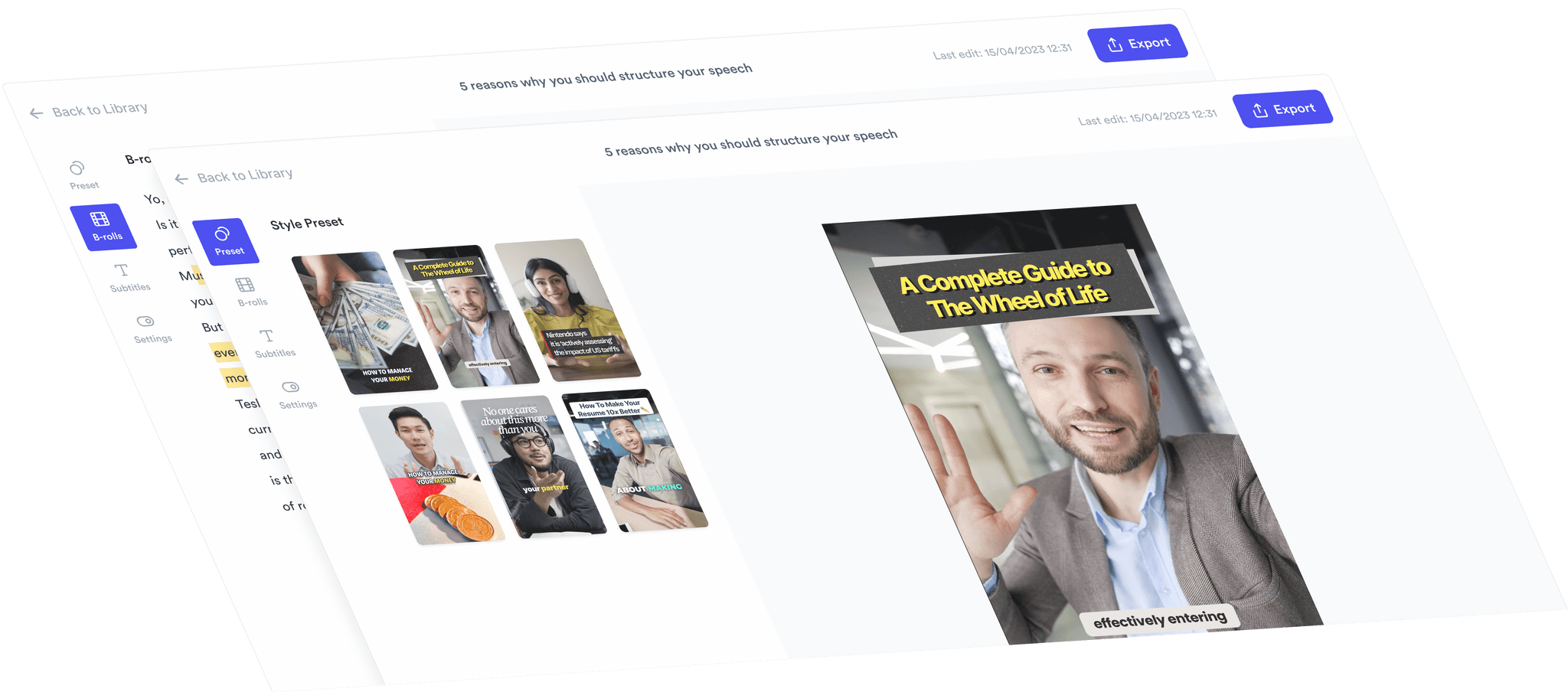
What a prospect is evaluating cannot be delegated: the way you explain, the opinions you hold, the way you come across on camera. Those deserve the hours. The loop that follows, cutting silence, placing captions, finding B-roll, adding sound, is the same every time, and it is the part that stops busy coaches from posting. Jupitrr produces that first edit from an uploaded recording, and scheduling and analytics sit in the same tool; how coaches use it is on Jupitrr for coaches, and the wider choice of editors is compared in the best video editors for coaches.
The strategy does not depend on the tool. A coach who follows the funnel, keeps to one idea per video and publishes on a rhythm will grow with any editor. The tool only decides how much of the week that costs.
Continue with
- How to Make Talking-Head Videos More EngagingWhy talking-head videos feel boring, and the idea, storytelling and production framework that fixes it.→
- How to Write Hooks for Talking-Head VideosHook families that create tension, the text-hook versus spoken-hook split, and a one-line test before filming.→
- How to Record Videos Without Memorizing a ScriptFinish the script, read it aloud, split it into scenes and record one scene at a time instead of one long take.→
Frequently asked questions
As often as you can sustain without the quality of the ideas dropping, and on a rhythm you can keep for months. There is no magic number. Publishing more gives you more attempts, more feedback and more repetitions, which is how the underlying skills improve, but a burst of daily posts followed by three silent weeks teaches you less than two steady posts a week. Pick the cadence you can hold through a busy client month and treat the first hundred videos as practice.
Yes, but not in every post and rarely as a direct pitch. Most of a coach’s content should earn the next interaction: a comment, a DM, a download, a webinar signup. Selling lives in bottom-of-funnel videos such as client stories, walkthroughs of what working together looks like and the occasional offer, aimed at the smaller audience already considering it. A feed where every Reel ends in a pitch trains viewers to leave before the pitch.
Top-of-funnel content, almost exclusively. With no audience there is nobody to nurture or convert, so the job is reach: myths, rankings, mistakes and reactions on broad topics that people outside your niche already understand and care about. Study creators in your category who already perform well, borrow the structure of their outlier videos, put your own expertise and voice into it, and publish enough to learn what your audience responds to.
Coaching is bought on the person, so in practice the business coach is the brand whether they build one deliberately or not. A prospect is evaluating how you communicate, how you think and whether they want to spend an hour a week with you; a talking-head video is the cheapest way to let them find out before a call. You do not need a logo, a colour palette or a slogan. You need to be recognisably yourself on camera, consistently.
Coach clients on camera, not in the timeline
Jupitrr turns a recording into a finished Reel with captions, B-roll and sound effects, so the hours go into clients and the next idea.